From the Mountains to the Bedside — Inside the First RM-RC Course
- Jul 3
- 3 min read
Updated: 4 days ago
Last month eleven healthcare providers from across British Columbia gathered in Fernie to take part in something entirely new: the inaugural Retrieval Medicine for Rural Clinicians (RM-RC) course. What unfolded over five days in the Canadian Rockies was not just a training program — it was the beginning of what we hope will become a growing provincial community of practice.

Why the course was created
Rural and remote communities in BC face well-documented gaps in prehospital and retrieval care. As a result rural clinicians are often thrust ad hoc into filling these unmet needs. Rural providers working in these settings — family physicians, nurses, rural generalists — are highly skilled clinicians, yet often haven’t received structured training in the specific challenges of managing patients outside of their hospital or clinic setting, including during inter-facility transport. Rural clinicians asked for the RM-RC course to meet that need directly: grounded in evidence, clinician-led, and built around the realities of practice in remote communities.
The goal was not to teach participants to become prehospital and retrieval medicine experts; it was to prepare them for the moments that already happen in Haida Gwaii, in the East Kootenays, in rural Northern BC — when the patient is sick, and they are left filling the unmet needs until MRBC is able to deliver its PHRM service.
Five days in Fernie
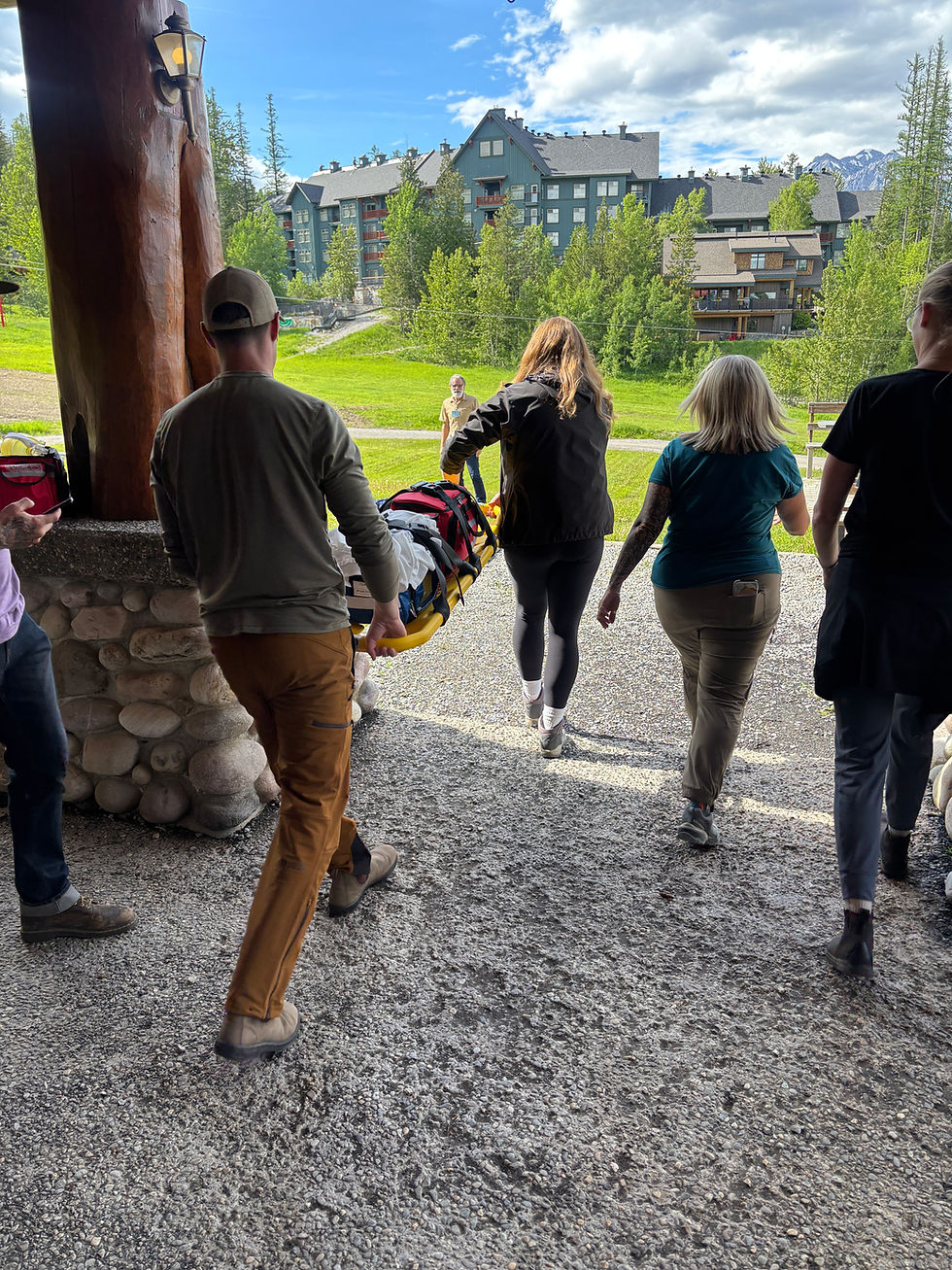
The course was deliberately experiential. Set in Fernie, BC — itself a community that understands remote medicine — participants moved through a carefully sequenced curriculum covering prehospital and retrieval medicine principles, airway management, patient packaging, haemorrhage control and trauma, shock, cardiac emergencies, obstetric complications, and mass casualty incident management.
Learning did not happen in a lecture hall. The program blended short, focused didactic sessions of 20 to 30 minutes with immediate practical application through high-fidelity simulations and hands-on skills stations. An outdoor AutoX vehicle extrication scenario brought an element of realism that participants consistently identified as a highlight. The instructors — drawn from a diverse pool of specialists, rural generalists, nurses, paramedics, and retrieval clinicians — brought depth, variety, and genuine passion to every session.
"The indoor/outdoor setting, shuffle of educators, and mix of theory, lecture and sim was outstanding. AutoX and scenario was brilliant!!" — Registered Nurse
"Such a perfect balance. 30-minute presentations then changing to scenario/skill helped keep my attention and enthusiasm." — Registered Nurse, 18 years' experience
What participants said
The feedback was unambiguous. Every participant indicated they would apply what they had learned in their clinical practice — and many described the course as transformative.
"This course has increased my confidence immensely in managing critically ill and injured patients. I know I will go back to work feeling better prepared to take on those sick patients instead of shying away." — Registered Nurse, 3 years' experience
"I feel more confident delivering safe care to isolated and vulnerable populations with long transport times." — Physician

Participants described concrete changes: adopting pre-transport checklists, changing how they package patients for interfacility transfer, developing more systematic approaches to airway emergencies. One registered nurse with eighteen years of experience described being shown for the first time the correct points of contact and safety positioning in the back of an ambulance — a gap she had never known existed.
"18 years — and nobody had shown me this!" — Registered Nurse
"My practice has improved because of this course." — Registered Nurse
A community of practice, not just a course
Perhaps the most consistent theme to emerge from participant feedback was not about skills — it was about belonging. Providers who often feel isolated in their rural settings described the experience of learning alongside peers from different professions and different communities as profoundly energizing.
"Everyone was here to learn — lift each other up!" — Registered Nurse, 18 years' experience
"Thank you a million times — 'Again Again Again × 3 — Please!'" — Family Physician
Several participants left Fernie with something more than new skills: they left with a plan. Plans to run simulations with their local teams. Plans to advocate for better equipment and resources. Plans to share what they had learned with colleagues who had never had this kind of exposure.
The view from here
The eleven providers who completed the RM-RC course in Fernie serve communities across BC. They go home to rural emergency departments, to small hospitals, to communities where the nearest specialist may be hours away by air. They go home better equipped — and more connected — than when they arrived.
MRBC's vision has always been that the right care, delivered by the right people, should be available wherever a patient needs it. The RM-RC course is one part of how that vision becomes real. If where someone lives is not going to determine whether they live, we need providers who are ready. Fernie was a start.
"Thank you for putting this course on — hopefully the start of something long overdue." — Rural Family Physician